Detector Simulation Projects
UCGretina
… is a Geant4 simulation of the Gamma Ray Energy Tracking Array (GRETA) – an array of gamma-ray tracking detectors used in nuclear physics experiments at ANL, the NSCL, and FRIB.
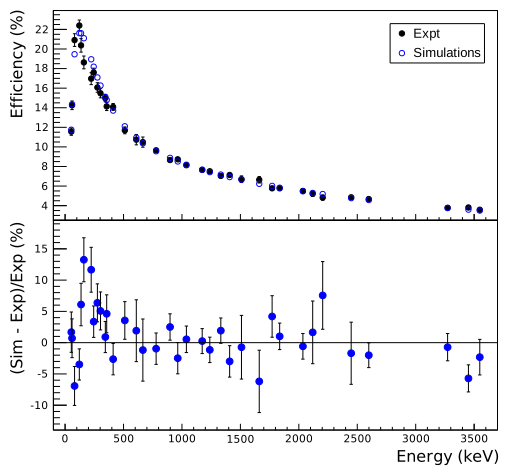
(Top panel) Measured (full circles) and simulated (open circles) full-energy peak efficiencies of the 12-quad standard NSCL configuration of the GRETINA array. (Bottom panel) Relative discrepancies between simulated and simulated and measured efficiencies.
UCGretina GEANT4 simulation of the GRETINA Gamma-Ray Energy Tracking Array, L. A. Riley, D. Weisshaar, H. L. Crawford, M. L. Agiorgousis, C. M. Campbell, M.Cromaz, P. Fallon, A. Gade, S. D. Gregory, E. B. Haldeman, L. R. Jarvis, E. D. Lawson-John, B. Roberts, B. V. Sadler, C. G. Stine, Nucl. Instr. Meth. A1003, 165305 (2021), arXiv:2104.09986.
UCCeBra
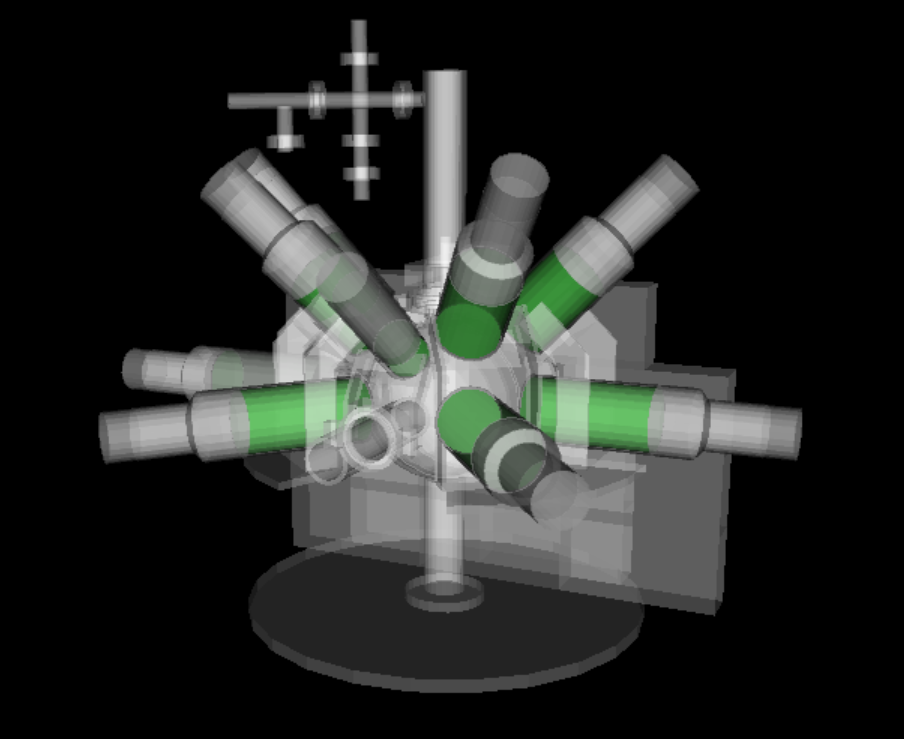
… is a Geant4 simulation of the Cerium Bromide Array (CeBrA) at the Fox Lab at Florida State University consisting of 14 Cerium Bromide (CeBr3) scintillation detectors surrounding the target position of the Super Enge Split-Pole Magnetic Spectrograph. The detector model was validated with source measurements at Ursinus by Ewan Chattin (UC Physics ‘26), Maddy Hickman (UC Physics ‘27), and Nathaniel Nerone (UC Mathematics ‘28) in summer 2025, and the material surrounding the target and detectors was added to the model by Hanna Ross (UC Physics ‘28) in summer of 2026.
Graphical visualization of the model of the CeBrA array as of summer 2026.
UCNa
… is a Geant4 simulation of the sodium iodide (NaI) scintillator detectors we use in our advanced laboratory courses for gamma-ray spectroscopy and cosmic-ray observation.
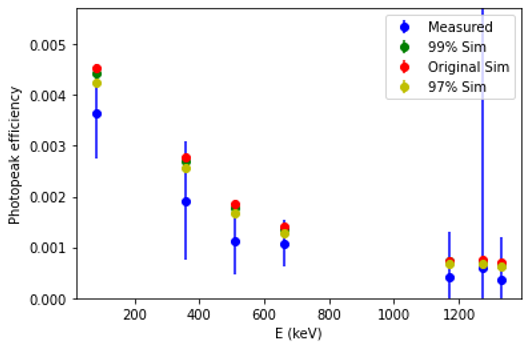
Ray Saunders collected source spectra and ran UCNaI simulations in Spring 2021. The simulations systematically over-predict the efficiencies. The green and yellow show simulations with reduced crystal volume.
Recent publications and work with students are highlighted on my Ursinus profile.